
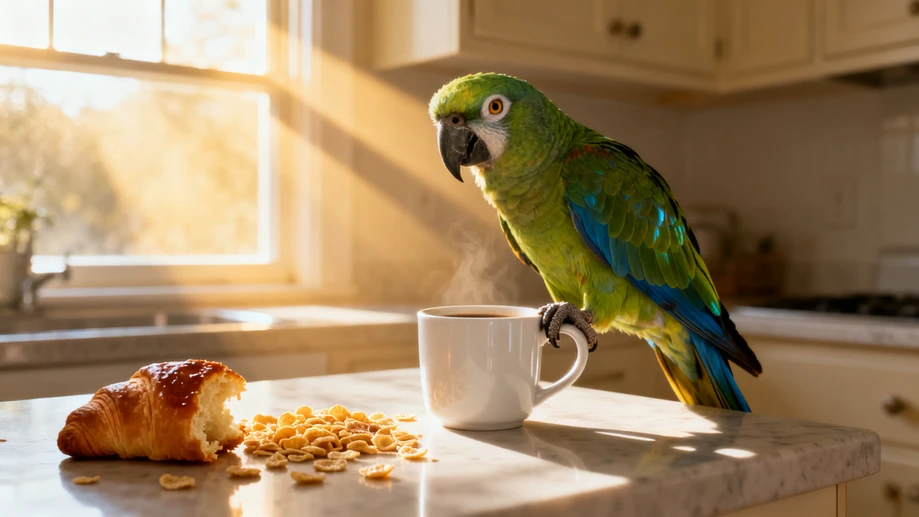
Does Your Parrot Secretly Run Your Household?
The Unspoken Hierarchy in Feathered Families
Picture this: you wake up, shuffle into the kitchen yearning for coffee, only to be met by the piercing stare of your Green Cheek Conure perched imperiously on the toaster. It chirps, not a request, but a clear demand for breakfast – *first*. This isn't an anomaly; it's the subtle, often hilarious, power shift that occurs when a parrot becomes part of your life. Forget the idea of humans being the undisputed masters of the roost. With intelligence rivalling a 5-year-old child and personalities as large as their vocal range, parrots, from tiny Budgies to majestic Macaws, have an uncanny knack for establishing themselves as demanding, opinionated, yet utterly beloved feathery CEOs of our homes. They don't just live with us; they orchestrate our routines and capture our hearts with their antics.
Their governance often begins with the fundamental control of sustenance. A parrot doesn't merely 'eat' when *you* offer food; it dictates the schedule and often demands a share of *your* meal. The rustle of a snack packet? That's the avian dinner bell, summoning them from across the house at warp speed. They develop an eagle-eyed precision for spotting forbidden human treats – chips, chocolate (dangerous, avoid!), or the prized French fry – deploying intricate aerial maneuvers or stealthy crawls to claim a prize. Witness the sheer strategy: a cockatoo might pretend disinterest in your sandwich while you're watching, only to execute a lightning-fast grab the millisecond you glance away. Or the amazon who learns that 'Drop it!' commands often result in a rewarding piece of something else offered as a distraction – clever negotiation tactics honed daily. Resisting those beady, expectant eyes demanding a 'just one bite' of your toast requires a will of steel.
Communication, or rather their masterful manipulation of it, is their key tool. Parrots excel at observational learning and vocal mimicry, turning it into powerful behavioral engineering. They quickly learn which sounds elicit immediate human action. The insistent piercing screech? Guaranteed to make you cover the cage or rush over to investigate. The perfectly timed "Hello?" chirp when you're on the phone? A demand for immediate attention hijacking your conversation. Then there's the passive-aggressive commentary: the quiet mutter of "Bad bird..." when *they've* just knocked over a plant, or the raucous wolf whistle aimed at an unsuspecting visitor. These vocalizations are rarely random; they're strategic ploys for amusement, interaction, food, or simply reminding you who truly holds the microphone in the household symphony.
Beyond the food wars and noise, parrots actively shape the physical and social landscape of your home. Your furniture arrangement suddenly revolves around cage placement (the best view, naturally), strategically placed climbing gyms, and safe window perches. That carefully curated bookshelf? It's now a potential jungle gym, perpetually monitored for curious beaks. Your social life bends to their rhythm; loud parties might be stressful, quiet evenings in are preferred. Guests are meticulously evaluated – some birds shower certain visitors with adoration (or demands for head scratches), while others subject newbies to loud alarm calls or the silent, suspicious stare-down until they pass some unknown feathery security clearance. Vacations become logistical puzzles requiring trusted bird-sitters and detailed care manuals. Simply put, your parrot's needs and whims become central coordinates around which the household navigates.
So, who's really in charge? The evidence is undeniable. You set the alarms, but the frantic dawn chorus becomes your true wake-up call. You buy the groceries, but their preferences dictate the fresh produce aisle purchases. You plan the quiet night, but their demand for a scratch session becomes the evening's highlight. While we provide safety, vet care, and love, they repay us by injecting chaos, laughter, and unparalleled companionship. They train us to understand their complex needs, respond to their unique calls, and structure our days around their fascinating avian rhythms. Living with a parrot isn't just ownership; it's entering into a dynamic, often humorous, partnership where the feathered member frequently holds the upper claw. Embrace the noise, laugh at their antics, and concede – your home is undeniably a shared dominion. Just don't tell them we admitted it; they might demand a raise in almond rations!